Last updated: October 2026
Attic mold is usually a moisture problem before it is a cleaning problem. Bathroom exhaust vented into the attic, blocked soffit vents, roof leaks, condensation, and warm air escaping through ceiling penetrations can all leave roof sheathing and framing damp enough for mold to grow.
ASM Mold Removal Inc. provides attic-focused mold inspection and remediation from Scarborough, with same-day response across Ontario for urgent moisture concerns. The service begins with a free inspection and moisture assessment, followed by containment, HEPA filtration, cleaning, source correction recommendations, and completion documentation.
What does an attic mold removal service include?
An attic mold removal service is a structured remediation process rather than a quick application of bleach or paint. The technician assesses visible growth and moisture, isolates the attic, controls airflow, removes contamination from suitable surfaces, treats affected wood, and helps address the condition that allowed the mold to develop.
The exact work depends on the attic’s size, accessibility, material condition, and contamination level. Clean, dry insulation may be preserved, while wet or visibly impacted insulation may need to be removed under containment.
Common signs of attic mold
- Dark or irregular spotting on roof sheathing, rafters, trusses, or nail lines.
- A musty or earthy odor that becomes stronger after rain, snowmelt, or humid weather.
- Frost, condensation, or damp nail tips during Ontario’s heating season.
- Discolored or compressed insulation near roof leaks, bathroom fans, or soffit edges.
- Repeated staining after a previous cleaning or repainting attempt.
Health Canada recommends inspecting attics, basements, crawl spaces, and other areas for visible mold, leaks, condensation, stains, and musty odors. Its guidance also emphasizes correcting the moisture source instead of focusing only on the visible growth.
When should you hire professional attic mold remediation?
Professional attic remediation is a sensible choice when contamination is extensive, hidden mold is suspected, growth keeps returning, or the source of moisture is unclear. Toronto public-health guidance indicates that areas of mold measuring four square metres or more should be addressed by a professional trained in mold remediation; smaller areas can still require professional help when access, safety, or moisture conditions make do-it-yourself cleaning unsuitable.
Situations that increase the need for professional help
- Large or widespread growth: Extensive contamination is difficult to isolate and clean without spreading particles.
- Recurring mold: Return of growth usually signals unresolved condensation, leakage, or ventilation problems.
- Suspected hidden contamination: Odor, staining, or moisture inside insulation and cavities may require a broader assessment.
- Water damage: A roof leak, plumbing issue, or prolonged condensation can affect framing and insulation beyond what is visible.
- Vulnerable occupants: People with allergies, asthma, or other sensitivities may prefer to avoid active disturbance of contaminated materials.
- Commercial or institutional spaces: Offices, schools, retail sites, healthcare facilities, and daycare settings need controlled work and clear documentation.
Air testing is not automatically required to decide whether visible mold should be removed. Ottawa Public Health notes that air testing does not explain the cause of mold damage or determine health risk by itself. A visual inspection, moisture assessment, and practical source correction plan are usually more useful starting points.
For public-health context, homeowners can review Health Canada’s guide to moisture and mould indoors.
How does attic mold removal work?
A reliable attic mold removal process connects assessment, containment, cleaning, drying, and prevention. Skipping the moisture investigation can leave the attic looking better temporarily while allowing the same condensation or leak to produce new growth.
1. Inspect the attic and locate moisture
The inspection documents visible staining, odor, insulation condition, ventilation paths, and likely entry points for moisture. Moisture meters, hygrometers, and thermal imaging can help identify damp areas, cold surfaces, air bypasses, and possible leaks, although equipment findings should be interpreted alongside the visual inspection.
2. Isolate the work area
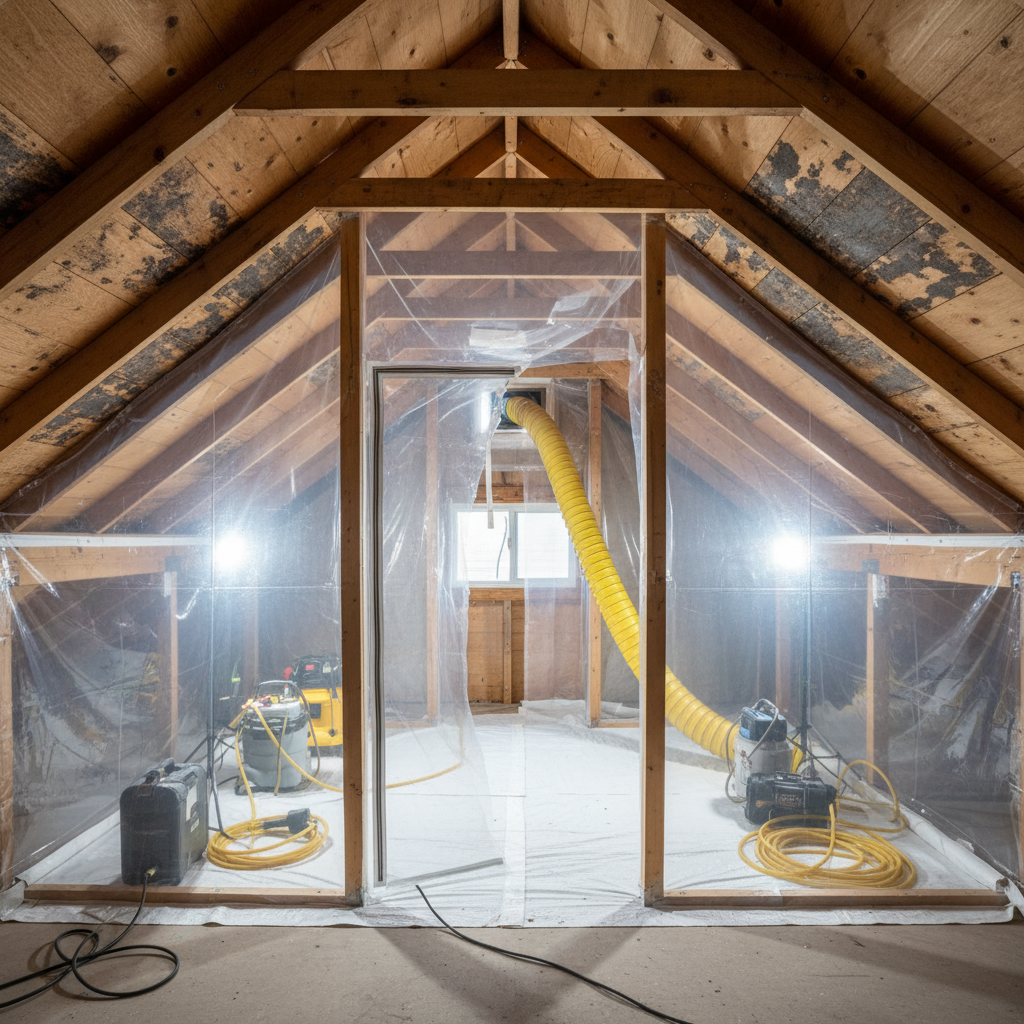
Access points are sealed with poly sheeting and the work zone is separated from occupied areas. Negative air equipment and HEPA filtration help direct and capture airborne particles so disturbance is controlled during cleaning.
3. Remove loose contamination
HEPA vacuuming removes loose spores, dust, and debris from accessible framing and sheathing. The crew uses appropriate protective equipment and work practices for the conditions found in the attic.
4. Clean adhered growth from suitable surfaces
Mechanical agitation, such as hand sanding or abrasive pads, may be used where staining or growth is attached to wood. The method must match the material and access constraints; aggressive treatment can damage surfaces or create unnecessary dust.
5. Apply treatment according to the product label
After physical cleaning, the provider may apply an appropriate antimicrobial product to affected wood surfaces. Products should be selected and used according to their labels, with attention to ventilation, occupant safety, and material compatibility.
6. Address the moisture source
Common recommendations include routing bathroom fans outdoors, clearing blocked soffit vents, installing or restoring baffles, sealing ceiling penetrations, improving insulation, and repairing roof or flashing leaks. Mold removal without source correction is unlikely to provide a durable result.
7. Verify and document the work
The final review checks visual cleanliness, moisture conditions, containment removal, and any remaining recommendations. ASM Mold Removal Inc. provides photographs and a Mold Remediation Warranty Certificate after completion and inspection, helping homeowners, buyers, sellers, and agents keep a record of the work.

Which attic mold remediation methods are used?
Most attic projects use a combination of source correction, HEPA vacuuming, mechanical cleaning, controlled treatment, and drying. The right combination depends on whether the contamination is loose or adhered, whether wood is sound, and whether insulation has been wet or visibly affected.
| Approach | Purpose | Important limitation |
|---|---|---|
| HEPA vacuuming | Removes loose particles and debris from accessible surfaces. | Does not remove the moisture source or all adhered staining. |
| Mechanical agitation | Loosens growth and staining attached to suitable wood surfaces. | Must be controlled to avoid unnecessary dust or surface damage. |
| Antimicrobial treatment | Supports cleaning and helps treat suitable surfaces after removal. | Does not replace physical removal or moisture correction. |
| Insulation removal | Removes material that is wet, visibly impacted, or not reasonably cleanable. | Clean, dry insulation may not need to be discarded. |
| Specialized media blasting | Can assist with heavy staining on appropriate open surfaces. | Requires careful containment, equipment, and material assessment. |
Painting or encapsulating active mold is not a complete remediation method. Coatings can hide staining while leaving contamination and moisture conditions in place, so removal, cleaning, drying, and prevention should come first.
How can you prevent attic mold from returning?
Prevention focuses on keeping humid indoor air out of the attic, maintaining ventilation, and repairing water entry. Ontario’s cold winters make condensation control particularly important because warm air contacting cold roof sheathing can leave recurring moisture even when there is no active roof leak.
Keep exhaust air out of the attic
Bathroom and kitchen fans should discharge outdoors through properly connected and sealed ductwork. A fan that terminates in the attic moves moisture into the exact space where condensation and mold can develop.
Protect soffit and roof ventilation
Insulation and debris can block soffit intake, while missing baffles can restrict airflow at the roof edge. A balanced ventilation path helps air enter at the soffits and leave through the designed exhaust system.
Reduce air leakage from the living space
Attic hatches, ceiling penetrations, recessed-light openings, plumbing chases, and electrical pathways can allow warm, humid air to rise. Air sealing these bypasses helps reduce condensation and improves the performance of the insulation.
Manage indoor humidity and repair leaks promptly
Use ventilation or dehumidification when indoor humidity is high, and investigate musty odors or new staining quickly. After a leak, drying should begin promptly and continue until affected materials are confirmed dry rather than judged only by appearance.

Health Canada recommends controlling humidity, repairing water damage diligently, and cleaning visible or concealed mold regardless of the species identified. The objective is a dry building with corrected moisture conditions, not merely a different color on the roof sheathing.
For workplaces and commercial properties, Ontario’s workplace mold guidance likewise emphasizes addressing both contamination and its source.
How do you choose an attic mold removal service in Ontario?
Choose a provider that explains the moisture source, containment plan, cleaning method, insulation decision, and verification process before work begins. A quote that only promises to spray or paint the attic does not explain how contamination will be removed or why it will not return.
Questions to ask before booking
- Will the inspection assess roof leaks, bathroom exhaust, soffit intake, insulation, and ceiling air bypasses?
- How will the attic be isolated from the occupied portion of the home?
- What HEPA filtration and protective equipment will be used during disturbance?
- Which materials can be cleaned, and which insulation or debris must be removed?
- What products will be used, and will they be applied according to their labels?
- What photos, moisture findings, recommendations, and completion documents will be provided?
- Does the prevention plan identify work that may require a roofer, insulation contractor, or HVAC professional?
ASM Mold Removal Inc. serves Scarborough and clients across Ontario for residential and commercial mold inspection, removal, and remediation. You can review the company’s approach and service background before arranging an assessment.
What should Scarborough homeowners consider?
Scarborough homes vary widely in age, roof design, insulation history, and ventilation upgrades. A previous insulation project may have covered soffit openings, while older bathroom renovations may have left exhaust ducts terminating in the roof cavity.
Seasonal freeze-thaw cycles and winter heating can make condensation patterns change quickly. A local assessment should therefore look at both visible staining and the way air and moisture move through the particular home, rather than treating every attic with the same cleanup plan.
Attic Mold Removal Service FAQ
How quickly can attic mold develop after a leak?
Damp building materials can support mold growth quickly when moisture remains and drying is delayed. The exact timeline depends on temperature, material, humidity, and the extent of wetting, so a prompt inspection and dry-out plan are more useful than waiting for a precise number of hours.
Can my family stay home during attic mold remediation?
That depends on the containment plan, attic access, work duration, and the occupants’ sensitivities. A properly isolated work area with controlled airflow can reduce migration into the home, but people with respiratory sensitivities may prefer to be away while materials are being disturbed.
Does moldy attic insulation always need to be removed?
No. Clean, dry insulation may be preserved when it is not visibly impacted and does not prevent access or source correction. Wet, heavily contaminated, or damaged insulation may need to be bagged and removed under containment before the attic is cleaned and restored.
Do I need mold testing before arranging removal?
Not necessarily. Visible mold, musty odor, moisture damage, and recurring condensation can justify corrective action without identifying the species. Testing may be considered in specific circumstances by a qualified professional, but an air test does not replace inspection or moisture correction.
How is successful attic remediation documented?
Documentation may include before-and-after photographs, moisture findings, a description of the work, remaining prevention recommendations, and a final inspection. ASM Mold Removal Inc. also provides a Mold Remediation Warranty Certificate after completion and inspection.
Book an attic mold assessment in Ontario
If you see attic staining, smell mustiness, or suspect a leak, arrange an inspection before cleaning or painting over the affected area. ASM Mold Removal Inc. offers free inspection and moisture assessment with same-day response from its Scarborough operation. Request an attic mold assessment or call 647-451-0493.
For broader indoor-air guidance, consult Health Canada’s residential mold guideline alongside advice from your remediation professional.


