Last updated: October 2026
By Amardeep Mamidi • Refreshed October 27, 2026
| Question | Practical answer |
|---|---|
| What does attic mold removal involve? | Inspection, moisture-source correction, controlled cleaning or removal, drying, and final verification. |
| When is professional help appropriate? | When growth is extensive, hidden, recurring, connected to moisture damage, or difficult to access safely. |
| What local conditions matter? | Ontario winters, freeze-thaw cycles, ice damming, warm-air leakage, blocked soffits, and improperly routed exhaust. |
| What does ASM provide? | Attic-focused remediation, containment, HEPA filtration, insulation and ventilation work, documentation, and a Mold Remediation Warranty Certificate after completion and inspection. |
When Attic Mold Needs Professional Help
Small surface staining can be difficult to interpret from below the attic hatch. Dark marks may reflect old moisture, active condensation, roof leakage, or biological growth, and the appearance alone does not identify the source. The right first step is to avoid disturbing the material and determine whether moisture is still entering or condensing in the space.
Health Canada identifies professional involvement as appropriate when mould covers more than three square metres, returns after cleaning, is suspected inside walls or above ceilings, or follows flooding that entered cavities. Those situations require more than a household spray because the affected material, moisture pathway, and work area all need to be assessed. See the Canadian guidance on moisture and mould indoors for the broader decision framework.
Professional attic mold removal is also sensible when insulation is wet or matted, access is restricted, growth is widespread across several rafter bays, or the attic is connected to a real-estate transaction. A remediation crew can set up containment, use HEPA-filtered equipment, identify hidden moisture, and document the condition before and after the work. That record is useful when homeowners, buyers, agents, insurers, and contractors need the same explanation.
Do not brush, scrape, or vacuum suspicious growth with an ordinary household vacuum before an assessment. Disturbing contaminated material can spread particles into the attic and potentially toward the living area. If there is active water entry, address the urgent leak safely while keeping the affected area as undisturbed as possible.
Why Attics Develop Mold in Ontario
Ontario attic mold is commonly associated with roof leaks, ice damming, warm household air entering the attic, bath or dryer exhaust terminating indoors, blocked soffit intake, and insulation gaps. These causes can overlap: a small air leak can create a cold surface, while inadequate ventilation prevents the moisture from leaving.
Winter conditions make attic moisture problems especially visible. Warm indoor air contains more moisture than cold outdoor air. When that air escapes through gaps around a hatch, plumbing stack, light fixture, chimney, duct, or partition wall, it can meet cold roof sheathing and condense. Repeated condensation can wet wood, rust nail tips, compress insulation, and create conditions where growth develops.
Roof leaks and ice damming
Roof penetrations, damaged flashing, missing shingles, and failed seals can wet the same rafter or sheathing area repeatedly. Ice damming creates a different route: snow melts on a warmer roof section, refreezes at a colder eave, and can allow water to move beneath roofing materials. Staining near eaves does not prove the cause, so the roof exterior and attic interior should be considered together.
Bath and dryer exhaust problems
Exhaust fans should discharge outdoors through suitable, sealed ductwork. If a bath fan ends in the attic, every shower can introduce warm, moist air to cold surfaces. A dryer that vents into the attic can add both moisture and lint, creating a serious building-performance and fire-safety concern. Rerouting the duct is part of correcting the cause; cleaning the resulting stain alone is not.
Blocked soffits and air leakage
Attic ventilation depends on a functioning path for intake and exhaust. Insulation can cover soffit openings when baffles are absent, while unsealed bypasses can allow household air to enter the attic continuously. CMHC material on mould in housing explains how warm, moist air entering through openings around fixtures and penetrations can cause winter condensation; its attic moisture and mould information provides useful cold-climate context.
Scarborough homes experience the same broader Ontario pattern: cold winters, rapid temperature changes, wind-driven rain, and freeze-thaw events. Local weather does not create mold by itself, but it exposes weak airflow, roof details, and air barriers. The durable solution is to identify the specific moisture path at the property rather than apply a generic treatment.
Signs of Attic Mold Homeowners Should Check
Common warning signs include irregular dark staining on roof sheathing, fuzzy or speckled growth on rafters, a musty odour near the hatch, rusty nail tips, and insulation that is damp, clumped, or sunken. These signs do not identify a species or prove that growth is active, but they justify a careful inspection and moisture assessment.
- Staining along eaves or seams: Patterns can indicate recurring condensation or water movement, especially when they expand after rain or a thaw.
- Visible textured growth: Fuzzy, powdery, or irregular material on wood should not be brushed away casually. Photos from a distance can help an assessor understand where it is located.
- Musty odour: A smell at the hatch, ceiling access panel, or upper floor may indicate moisture or hidden growth, although odour alone cannot diagnose the problem.
- Rust on fasteners: Rusty nail tips and metal connectors can show that warm, moist air has repeatedly reached cold surfaces.
- Changed insulation: Wet, compacted, displaced, or discoloured insulation can signal a leak, condensation, or a ventilation obstruction.
Do not enter an attic if the floor is unsafe, the access is inadequate, electrical hazards are present, or you have a health condition that makes exposure a concern. A homeowner can observe from the hatch using a light and phone camera, but should not crawl across loose-fill insulation or step between ceiling joists. If the issue is in a workplace, school, healthcare setting, or other occupied commercial building, Ontario’s mould guidance for workplace buildings reinforces the importance of addressing sustained or extensive visible growth and its moisture source.
How Professional Attic Mold Removal Works
A responsible attic mold removal project begins with inspection and moisture-source identification, followed by containment, HEPA filtration, controlled cleaning or removal, drying, and prevention work. The exact sequence depends on the extent of growth, the condition of insulation and wood, access, and whether roof or mechanical repairs are required.
1. Inspection and work planning
The technician reviews the history of leaks, condensation, odour, renovations, and previous cleaning. The attic is examined for roof penetrations, wet or deteriorated materials, air bypasses, soffit openings, exhaust routes, and insulation coverage. Moisture readings and photographs help distinguish a current concern from an old, dry stain, although no single instrument replaces a complete assessment.
2. Containment and air control
Before disturbing affected material, the crew protects the hatch and nearby surfaces with appropriate barriers. HEPA-filtered air equipment can help control airborne particles within the work area. Containment is not a substitute for source correction, but it reduces the chance that cleaning activity spreads dust and debris through the home.
3. Surface cleaning and material removal
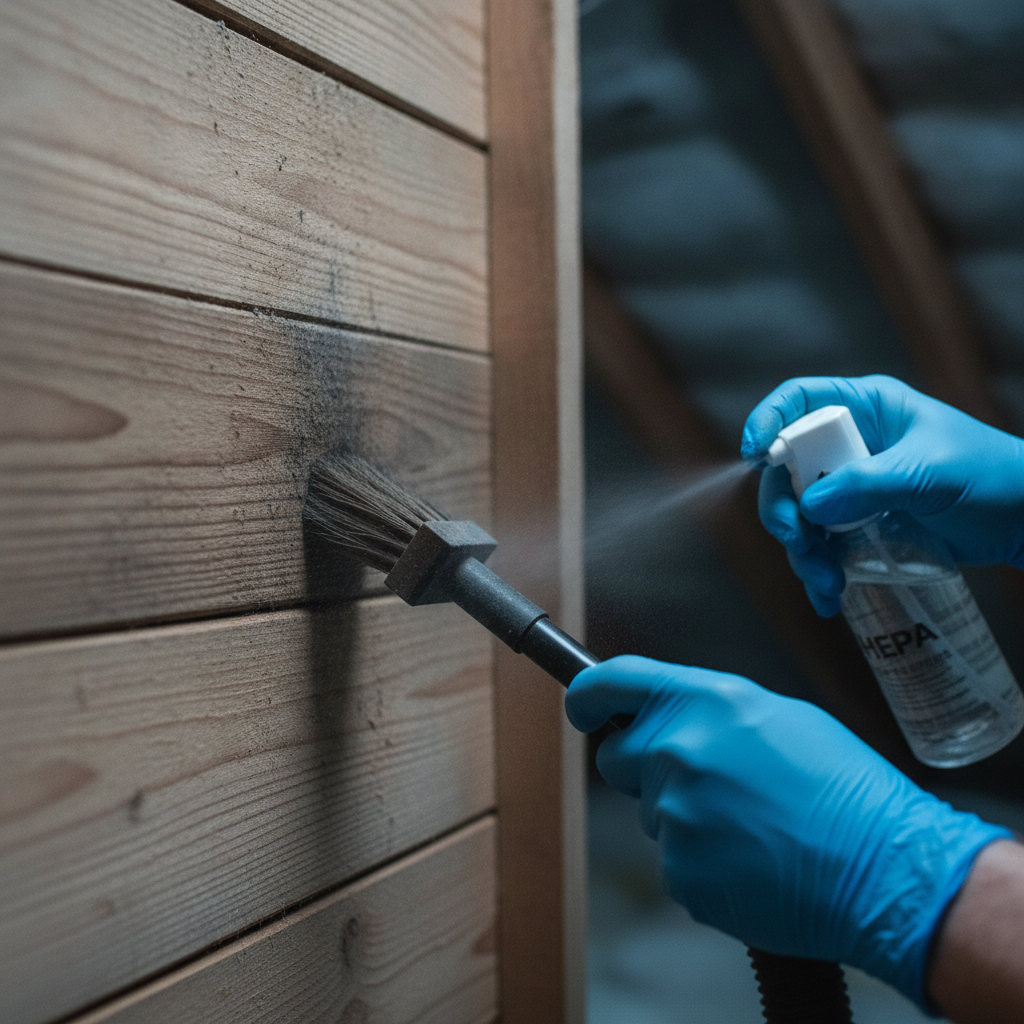
Sound, cleanable wood may be mechanically cleaned using controlled methods such as wire brushing and HEPA vacuuming. Porous insulation that is wet, contaminated, or unable to be effectively cleaned may need removal and disposal. A product applied over dirt, loose growth, or wet wood is not a complete remediation method.
4. Treatment and drying
After physical cleaning, an appropriate EPA-approved product may be used according to its label and intended application. Treatment does not replace removal of contaminated porous material or correction of moisture. The wood and surrounding assembly should be dry before insulation is replaced and the attic is closed up.
5. Moisture-source correction
The project may include opening soffit intake with baffles, sealing attic bypasses, correcting duct termination, improving insulation placement, or coordinating roof repairs. Some work may require a roofer, HVAC professional, electrician, or other trade. A clear scope should identify what the remediation contractor will complete and what remains outside the scope.
6. Final review and documentation
At completion, the homeowner should receive an explanation of the work, photographs where available, prevention recommendations, and any agreed inspection or warranty documentation. ASM Mold Removal Inc. provides a Mold Remediation Warranty Certificate after completion and inspection. The certificate should be understood alongside the scope and any conditions that could create new moisture later.
| Project stage | Decision it addresses |
|---|---|
| Assessment | Where is growth or moisture located, and is the source active? |
| Containment | How will the work area and nearby living spaces be protected? |
| Cleaning or removal | Which materials can be cleaned and which are too porous or damaged? |
| Drying and treatment | Are surfaces physically clean and dry before closure? |
| Repairs | What must change in the roof, exhaust, insulation, air barrier, or ventilation? |
| Verification | What evidence shows the agreed work is complete? |
Insulation and Ventilation Decisions
Insulation is part of the moisture solution, not merely a finishing material. Wet or contaminated insulation can hold moisture against cold surfaces, conceal damage, and obstruct soffit intake. Replacing it before the wood is clean and dry can hide the original problem and make a future inspection harder.
When insulation may need removal
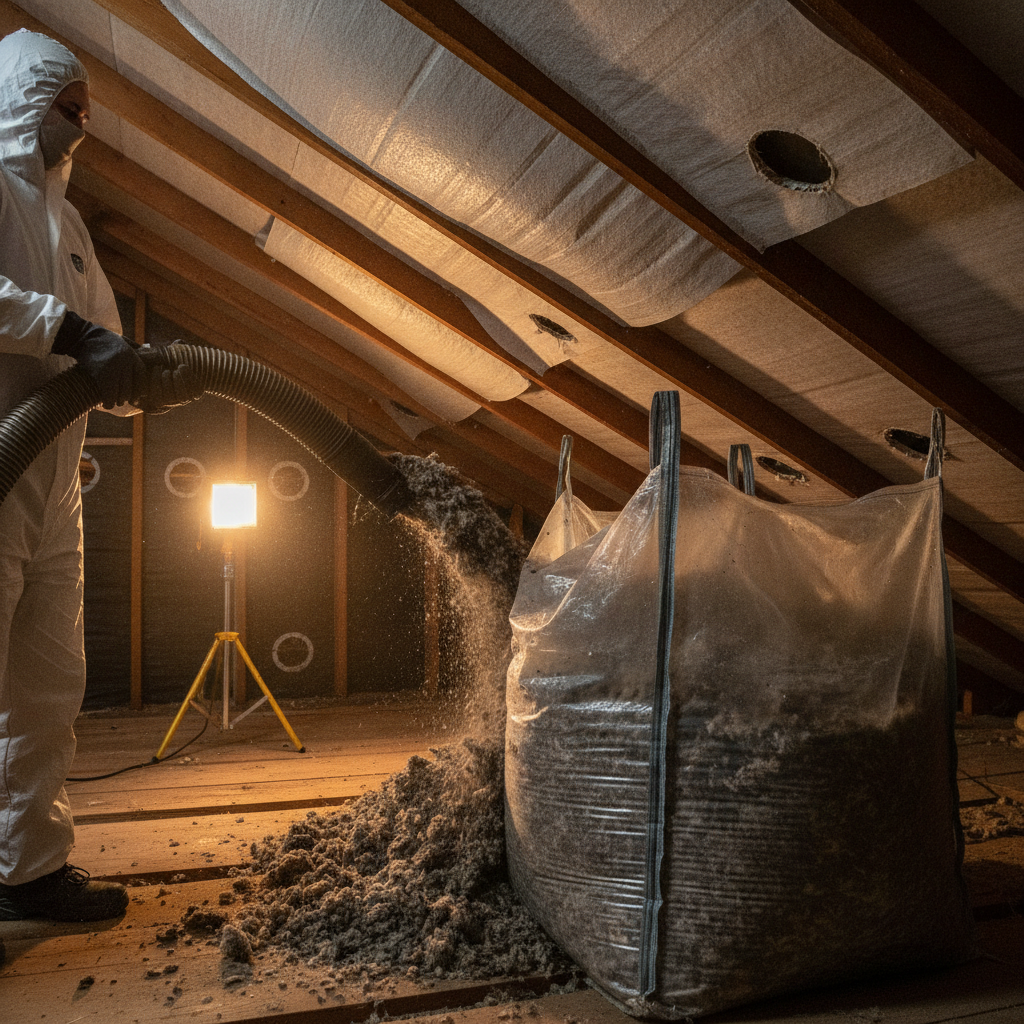
Removal is more likely when insulation is visibly wet, mould-affected, heavily compacted, contaminated by sewage or floodwater, or preventing access to damaged surfaces. The decision should consider the material type, contamination, extent, and whether effective cleaning is possible. Sealed bags, suitable equipment, and a controlled route out of the home help limit dust during extraction.
What ventilation corrections can include
- Soffit baffles: These help preserve a clear intake channel where insulation might otherwise block airflow.
- Air sealing: Gaps around hatches, plumbing, wiring, chimneys, and other penetrations can be sealed using suitable materials and methods.
- Exhaust correction: Bath and dryer ducts should discharge outdoors through properly connected and sealed routes.
- Balanced intake and exhaust: Ventilation components work as a system; adding an exhaust vent without adequate intake may not solve the moisture problem.
- Insulation placement: New insulation should be installed without covering required airflow paths or creating uneven cold areas.
Ventilation is not a universal cure. A roof leak still needs roof repair, and excessive indoor humidity may require changes inside the home. The inspection should connect each proposed correction to an observed moisture mechanism.
What to Expect During an Attic Inspection
An inspection should begin with questions, not a predetermined treatment. Expect discussion of roof age and repairs, recent leaks, ice dams, bath and dryer exhaust, indoor humidity, odours, previous remediation, and the reason the attic was inspected. If a home sale is involved, explain the reporting deadline so the scope can prioritize useful documentation.
The assessor may photograph the attic, inspect rafter bays and eaves, check insulation condition, trace ducts, examine roof penetrations, and take moisture readings. Thermal imaging or targeted air testing may be useful in selected situations, but visible growth and a known moisture source do not automatically require air testing before work. Testing should answer a defined question rather than delay obvious source correction.
ASM Mold Removal Inc. offers Ontario-wide same-day inspections subject to availability, with its base in Scarborough. An inspection is not a guarantee that remediation can begin the same day: access, material removal, equipment, weather, trade repairs, and the extent of contamination affect scheduling. The written plan should identify urgent actions, proposed work, exclusions, and the expected verification process.
For general health information, homeowners can review the CDC overview of mould and health. It is educational guidance, not a property-specific diagnosis. People with asthma, allergies, immune suppression, or other health concerns should discuss personal risk with a qualified healthcare professional.
A Practical Attic Mold Removal Checklist
Use this checklist when comparing scopes or preparing for an inspection. It focuses on decisions that affect whether the result lasts, not on a particular brand of chemical or a superficial change in appearance.
- Record when the odour, staining, leak, or condensation was first noticed.
- Photograph the attic from the access opening without disturbing suspicious material.
- Ask whether the source is a roof leak, indoor air leakage, exhaust problem, blocked intake, or another condition.
- Confirm how the work area will be contained and how equipment will be filtered.
- Ask which wood, insulation, or other porous materials will be cleaned, removed, dried, or replaced.
- Request a clear explanation of ventilation, soffit, air-sealing, and duct corrections.
- Ask whether roof, HVAC, electrical, or other trade work is included or must be arranged separately.
- Confirm what photographs, readings, reports, inspection notes, or warranty documents will be supplied.
- Keep receipts and records of repairs, especially when a property sale or insurance file is involved.
Avoid choosing solely on a promise that every stain will disappear or that one application will prevent all future growth. Mold can return if a new leak develops, indoor humidity remains high, or a repair is incomplete. The strongest scope connects the observed evidence to specific corrective actions and explains the limits of the warranty or guarantee.
Attic Mold Removal FAQ
Is attic mold removal the same as cleaning a few dark stains?
No. Cleaning stains may improve appearance, but attic mold removal should address whether the material is contaminated, whether it can be effectively cleaned, and why moisture reached the area. A durable project combines controlled cleaning or removal with drying and correction of leaks, air leakage, exhaust, insulation, or ventilation problems.
Do I need mould testing before attic remediation?
Not necessarily. Visible growth plus a confirmed moisture source can provide enough information to begin appropriate corrective work, while testing may be useful for a defined real-estate, health, or post-remediation question. Testing should be selected based on what decision it will inform, not used as a substitute for correcting an obvious leak or condensation source.
Can attic mold come back after professional removal?
It can return if moisture conditions return. New roof leaks, blocked soffits, unsealed bypasses, indoor humidity, or an exhaust duct that still terminates in the attic can recreate the problem. Ask the contractor to document the prevention work and explain which future conditions are outside the original scope.
How long does attic mold removal take?
The schedule depends on attic size, access, the extent of growth, insulation removal, drying, containment, and required ventilation or roof corrections. A modest project may be completed quickly, while a larger or recurring problem can require additional days and coordination with another trade. The inspection and written scope should establish a realistic sequence rather than promise a universal timeline.
What should I do if I find attic mold before selling my Scarborough home?
Document the condition without disturbing it, arrange an assessment, and ask for a written scope that identifies the moisture source and proposed verification. If the closing timeline is short, tell the contractor at the first contact so inspection, remediation, repairs, and documentation can be coordinated. Do not conceal staining with paint or insulation before the cause is understood.
Arrange an Attic Mold Assessment in Scarborough
If you have noticed attic staining, a musty odour, wet insulation, condensation, or a recurring roof-related problem, ASM Mold Removal Inc. can assess the space and explain the next step. The team serves Ontario with an attic-focused approach that combines containment, HEPA filtration, cleaning or material removal, insulation work, ventilation corrections, and completion documentation.
Request an attic inspection and discuss your situation with ASM Mold Removal Inc.


